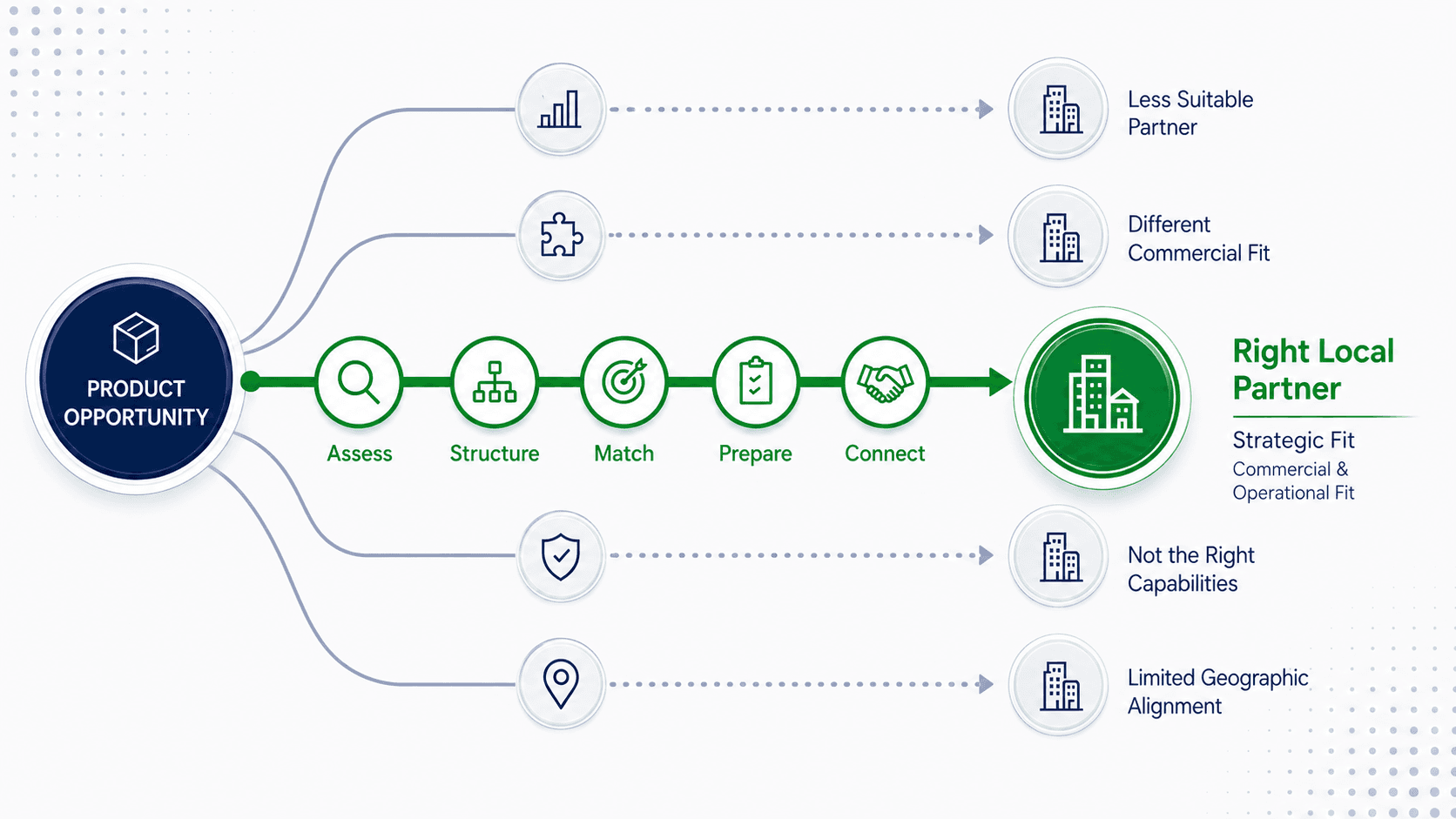
A partner should fit the opportunity
There is no single distributor profile that works for every healthcare product.
A partner that performs well in one therapeutic area may not have the right relationships, commercial focus or operational capabilities for another.
A company with broad market coverage may still be unsuitable if the new product would receive limited attention within its portfolio.
The right partner depends on the opportunity itself.
That includes the product category, target customers, expected route to market, competitive environment, required level of investment and the company’s longer-term plans for the market.
This is particularly important in pharmaceuticals, nutraceuticals, biotechnology, medical technologies and veterinary healthcare, where different products may require very different commercial, technical and regulated activities.
Partner selection should therefore follow opportunity assessment, not replace it.
Five questions that help determine partner fit
1. Does the partner understand the product category?
General market presence is not always enough.
A potential partner should understand the commercial realities of the relevant category, including its customers, purchasing behaviour, competitive landscape and the type of support required after launch.
A partner may have a strong pharmaceutical business, for example, but limited experience in a specialist hospital product, a veterinary portfolio or a medical technology that requires a different sales approach.
Category relevance is usually more valuable than portfolio size alone.
2. Can the partner reach the right customers?
Market coverage should be examined in practical terms.
The important question is not simply whether a distributor operates nationally. It is whether the company has meaningful access to the channels and customer groups that matter for the product.
Depending on the opportunity, this may include hospitals, pharmacies, private healthcare providers, institutional buyers, specialist physicians, laboratories, veterinary channels or other defined customer segments.
A large network can be useful, but only when it connects the product to the right part of the market.
3. Will the opportunity receive enough attention?
A product can be commercially attractive and still become a low priority for the local partner.
This often happens when the distributor manages a large portfolio, has competing commitments or sees the opportunity as a small addition rather than a business it intends to develop.
Before moving forward, both sides should understand how the product would be positioned within the partner’s portfolio.
- Who would be responsible for it?
- What resources would be assigned?
- What would the partner need from the manufacturer?
- How would progress be reviewed?
Early clarity on these points is more useful than general expressions of interest.
4. Are commercial expectations aligned?
Many partnerships face difficulty because the parties begin discussing commercial terms before agreeing on the commercial logic of the opportunity.
The manufacturer may be focused on long-term market development, while the local partner expects immediate volume.
One side may assume that significant launch investment will be made, while the other expects the brand owner to provide most of the support.
These differences are not necessarily problems. Unspoken differences are.
A serious partner discussion should cover expected demand, pricing logic, launch investment, promotional responsibilities, supply considerations, timelines and the definition of commercial success.
The objective is not to force early agreement on every detail. It is to identify whether both sides are evaluating the same opportunity.
5. Is the opportunity ready for partner engagement?
Partner selection is not only about evaluating the distributor. The opportunity itself must also be ready to present.
A local partner cannot make a meaningful assessment based only on a product catalogue and a request for market feedback.
At a minimum, the discussion should explain:
- what the product or portfolio is;
- why the target market is being considered;
- the intended commercial model;
- the available regulatory and technical status;
- the expected role of the local partner;
- the support available from the product owner; and
- the decisions that need to come from the discussion.
Good preparation allows the partner to respond to a defined opportunity rather than a general enquiry.
Saudi Arabia and Libya require different partner logic
Saudi Arabia and Libya both offer opportunities for international healthcare companies, but they should not be approached as interchangeable markets.
Saudi Arabia is a structured and competitive healthcare market. A potential opportunity requires clear preparation, realistic positioning and alignment with a partner capable of operating within the relevant commercial and regulated environment.
Libya relies heavily on local market understanding, established relationships and the ability to assess how an opportunity can work in practice.
The quality and reliability of the local partner can have a significant effect on whether a promising product develops into an executable business opportunity.
In both markets, local presence matters. The capabilities required from that local presence, however, may differ according to the product, channel and intended business model.
This is why partner selection should be market-specific and opportunity-specific.
A better way to approach partner selection
A useful partner-selection process can be structured around five stages.
01Assess
02Structure
03Match
04Prepare
05Connect
Assess
Start with the product and the market opportunity. Review the category, competitive context, commercial rationale, available documentation and the objectives of the company seeking market entry.
The purpose of this stage is to determine whether there is a sufficiently defined opportunity to take forward.
Structure
Translate the initial interest into a clear engagement case. Define the target market, the potential model, the information available, the expected partner role and the questions that still need to be answered.
This provides a more useful basis for evaluating potential partners.
Match
Identify partners based on relevant capabilities, not only on availability.
The strongest candidate is not necessarily the largest distributor or the first company to respond. It is the company whose portfolio, relationships, operating capabilities and commercial priorities are most closely aligned with the opportunity.
Prepare
Organise the information required for a focused discussion. A prepared opportunity allows both parties to spend less time clarifying basic facts and more time evaluating feasibility, responsibilities and potential.
Connect
Introduce the opportunity to the most relevant potential partner and manage the discussion around defined objectives.
The value of an introduction is not measured by the number of companies contacted. It is measured by whether the discussion moves the opportunity closer to a sound commercial decision.
Partner selection is a strategic decision
Finding more distributors rarely improves the quality of a market-entry decision. Finding the right partner usually does.
A long list of potential distributors may create activity, but it can also produce inconsistent feedback, unclear expectations and repeated discussions with companies that were never suitable for the opportunity.
A more selective approach may lead to fewer introductions, but each discussion is more relevant.
The product owner receives more meaningful market feedback. The local partner evaluates an opportunity that has already been considered in relation to its capabilities. Both sides can focus earlier on feasibility, responsibilities and commercial fit.
The local partner influences execution, commercial priorities, coordination and the long-term development of the opportunity.
For that reason, partner selection should never be treated as a simple sourcing exercise. It is one of the most important strategic decisions in the entire market-entry process.
Finding a distributor may be the request. Finding the right strategic fit should be the objective.